Wstęp
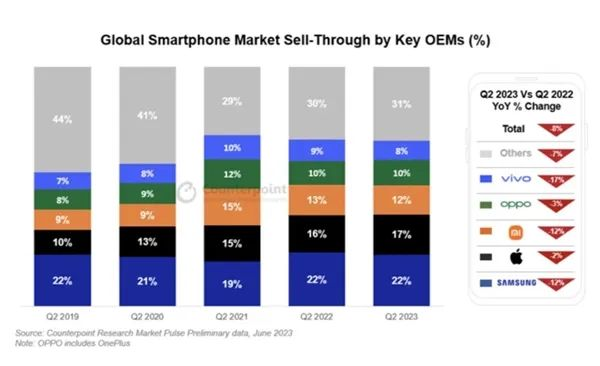
The world of smartphones is a dynamic landscape, constantly evolving and presenting new challenges and opportunities. As we delve into the latest report by research firm Counterpoint, it is evident that the global smartphone market faced a downturn in the second quarter of 2023, with sales declining by 8% year-on-year and 5% sequentially. Surprisingly, this marked the eighth consecutive year of year-on-year declines, leaving major smartphone manufacturers astounded. However, amidst this turbulent environment, the size of the market provides some resilience to weather the storm.
Global Smartphone Top 5: Rise of Domestic Brands
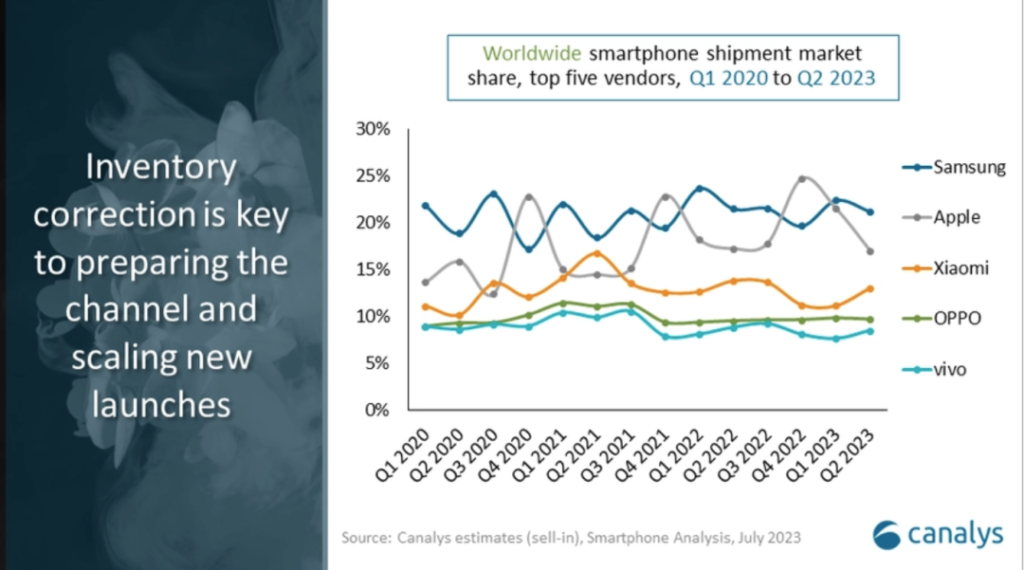
Despite the overall decline in smartphone sales, the market’s landscape has seen minimal changes in terms of market share distribution. In this quarter, Samsung and Apple retained their positions at the top, holding 22% and 17% of the market share, respectively. Together, they dominate almost half of the global smartphone market.
Domestic Brands Take Center Stage
Following closely behind Samsung and Apple are Xiaomi (12%), OPPO (10%), and vivo (8%), forming the other significant portion of the market. Huawei and Honor did not secure a spot in the top 5.
Apple and Samsung: A Tale of Two Giants
Apple’s placement in the second position during the year’s first half is unsurprising, given their strategy of launching new products in the autumn after their keynote events. Despite innovative promotional efforts, including integrating Apple Store official mini-programs and live-streaming events to attract loyal customers, the impact on sales has been marginal. However, the company still demonstrates resilience in the high-end segment, stimulating sales with well-timed price adjustments.
A Giant Facing Challenges
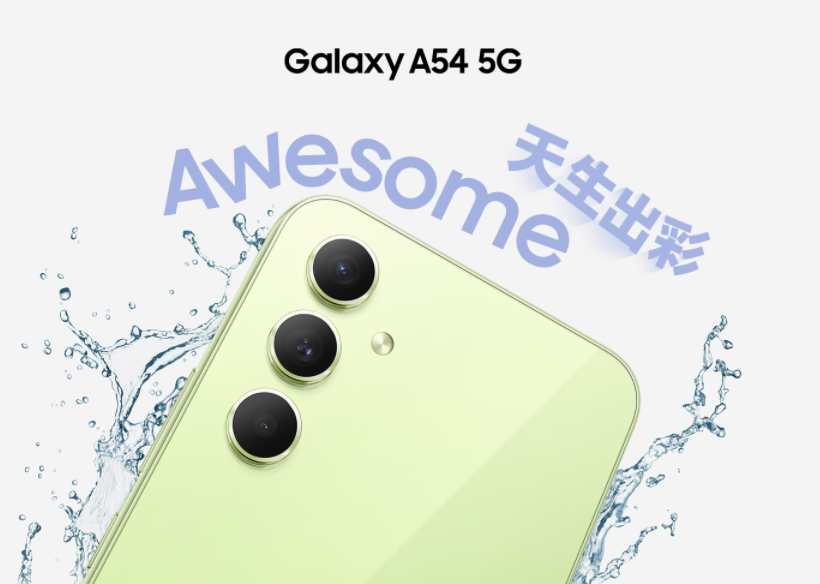
On the other hand, Samsung continues to shine, leveraging its accumulated experience and brand reputation to maintain its standing in the global market. During the year’s first half, Samsung unveiled the Galaxy S23 series and the Galaxy A54. While the Galaxy S23 Ultra’s top-of-the-line version crossed the 10,000 yuan threshold at 12,699 yuan(1800USD), the Galaxy S23 standard variant started at 5,199 yuan(749USD). The Galaxy A54 caters to the mid-range market, reflecting Samsung’s strategic focus on both mid-range and high-end products.
New Innovations in High-end Market
Ponadto Xiaomi współpracowało z firmą Leica przy wprowadzeniu Xiaomi 13Ultra, pozycjonując go jako wysokiej klasy flagowiec z ceną początkową 5999 juanów (859 USD). Find X6 firmy OPPO, również wyceniony na 5999 juanów (859 USD), oraz X Flip i X Flod2 firmy Vivo z imponującymi składanymi ekranami przyczyniły się do rywalizacji wśród najlepszych graczy.
Pełna nadziei przyszłość: wzrost liczby flagowych urządzeń najwyższej klasy
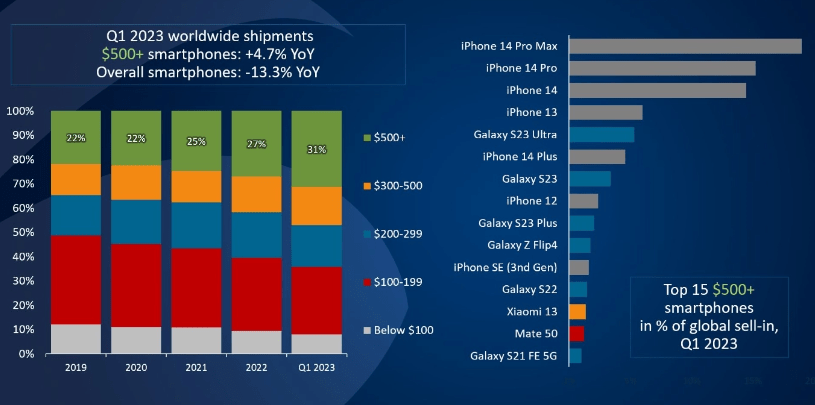
Despite the overall smartphone market’s challenges, high-end flagship devices have been showing continuous growth in shipment volumes. Counterpoint data indicate that during a period of stagnation in the global smartphone market in 2022, the high-end smartphone market experienced a 1% growth in sales and contributed over 55% of the overall market’s revenue.
Heading 3: A Ray of Light in High-end Segment
This upward trend continued in the second quarter of 2023, with high-end smartphones accounting for one-fifth of the total shipments. This means that for every five smartphones sold, one belongs to the high-end category. The popularity of foldable form factors became a fiercely contested battleground for companies like Samsung, Vivo, and OPPO.
Ustawa równoważąca: od klasy wyższej do średniej
Ponieważ cały rynek smartfonów wchodzi w fazę nasycenia, urządzenia z niższej półki utrzymują podejście oparte na wolumenie, podczas gdy urządzenia średniej klasy stają pod coraz większą presją ze względu na postęp technologiczny. Z kolei smartfony z najwyższej półki stają się centralnym punktem innowacji i zróżnicowania.
Znalezienie właściwej równowagi
Pojawienie się różnych flagowych urządzeń z najwyższej półki, w cenie około 5000 juanów, zapewniających duże marże zysku, wpisuje się w obecną dynamikę rynku. Co więcej, odporność sektora detalicznej sprzedaży towarów luksusowych podczas pogorszenia koniunktury gospodarczej sugeruje, że wpływ tej sytuacji na potencjalnych nabywców smartfonów z najwyższej półki pozostaje stosunkowo niewielki.
Wniosek
Druga połowa 2023 roku zapowiada ekscytujące premiery nowych smartfonów, w tym iPhone'a 15 i Huawei Mate 60. Producenci przygotowują się do ujawnienia swoich atutów i zabezpieczenia swojego udziału w rynku produktów high-end.
Przyszłość niesie obietnice
Jednak ten wzrost liczby urządzeń z najwyższej półki niesie ze sobą również wyzwania, ponieważ nasila się konkurencja i przyspiesza tempo aktualizacji. Pomimo niedawnego pogorszenia koniunktury na rynku istnieje nadzieja na “trochę wiosennego słońca” w branży smartfonów, ale zależy to przede wszystkim od zdolności segmentu high-end do wyciągnięcia rynku z obecnego zastoju.
Krajobraz smartfonów stale się zmienia i fascynujące będzie obserwowanie, jak producenci dostosowują się i wprowadzają innowacje, aby wyjść naprzeciw konsumentom’ ewoluujące potrzeby i pragnienia w nadchodzących miesiącach i później.